
The Euphorbia Perennial:
An Overlooked Show Stopper

In my busy days as a landscaper, I had one large estate where we developed dozens of different gardens or “outdoor rooms”. One outdoor room was along a driveway that wound through the property. It was sort of like an outdoor long wide hallway. All plantings were deer resistant. Flowering shrubs included rhododendron, clethra and itea. Ferns, thalictrum and soloman seal were some of the perennials we used. Ground covers included periwinkle (vinca), hypericum, ajuga and pachysandra.
There was a length of 50 feet that had moist, clay soil and dappled shade. I could not figure out what to plant. I had used up my repertoire of deer proof plant material.
I scoured the huge perennial section at a nearby nursery and finally grabbed a tall blue perennial I saw at the far end of the nursery tent. The blue foliage would be a good addition to what I had. “That’s a good one!”, said my nursery friend. At $8 a piece, a dozen went into the back of my truck.

Year after year, I drove past the stand of blue euphorbia whenever I entered the property. It spread to fill a good portion of the 30′ area. We never cut it back or deadheaded it because it always looked great.
Euphorbias belong to a genus of 2000 varieties also know as spurges. They include annual herbs, perennials, shrubs and even small trees. Some spurges you may recognize as cacti and poinsettias!
They are used in pots, rock gardens, borders, meadows and more. They are popular for their easy maintenance and toughness, as well as varied leaf colors and small flowers.
The photo below is a really eclectic garden we did years ago. You can see a single euphorbia to the right of the red jap maple on the upper tier. It serves as the stunning focal point.

I loved using them as an accent in the pots below.


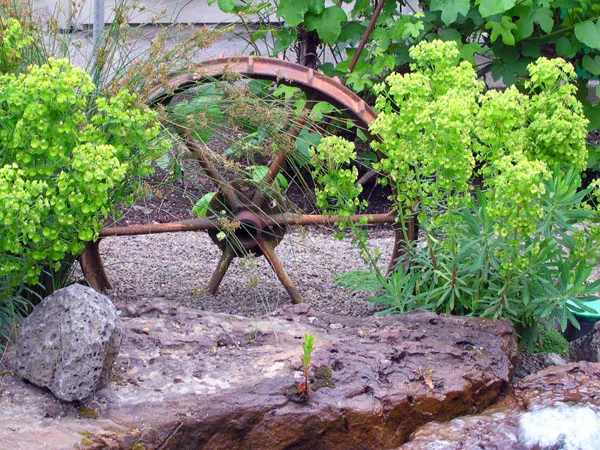
You may recognize this euphorbia. It is used often as a side planting to colorful bloomers.

Euphorbias take full sun or dappled shade. Their leaf color is more brilliant the more sun they get.


Some euphorbias are short lived, but for longer living species the care of euphorbias is to cut back the tiny, nondescript flowers after blooming. The flowers are unisexual which means there is no male and female.


Maintenance also includes cutting stems all the way to the ground in early spring and splitting the plant every 2-3 years.
A drawback for this species is the milky white sap called ‘latex’ that they exude when a stem is broken.

This latex sap causes burning and is an irritant to the eyes and skin. The caustic sap’s strength depends on what species you are working with. In any case, wear gloves when working with euphorbia, and don’t plant near a play area for kids or pets.
They can be slowly invasive. Their seeds literally explode when finished blooming. I have one I love but it spreads everywhere in my perennial bed. I choose which ones I want to keep and easily pull the others out.
For the summer of ’25 the party is almost over for nurseries stocking a variety of perennials. You may be regaled as a crazy gardener if you plant anything in the next hot 2 or 3 months. Call me crazy! I bought 6 perennials yesterday to fill a few empty spaces in my kitchen garden. Three of them were, you guessed it, euphorbia.


Christie lives in Manakin Sabot , Virginia where she manages a 3 acre garden. Her blogs are written from her 35 years as a personal and professional gardener.
Leave A Comment